 Giveth
 donations: Project Giving and Network Fees
Giveth donations sent directly to projects arrive without a platform deduction from the donation amount. Network fees add to the donor's cost. The selected project must accept the payment network, and the wallet needs enough funds for both the contribution and its transaction fee.
Direct project gifts and pooled Causes
A direct project donation sends the contribution to the project's receiving wallet. You choose the recipient and amount before authorizing payment. This arrangement suits a gift intended for one particular project, with the recipient controlling the donated funds after the transfer completes.
A contribution to a Cause follows a different allocation model. The contribution is converted into GIV on Polygon and enters a pool. An AI-powered Donation Agent periodically allocates part of the pool among projects associated with that Cause. The distribution also includes allocations for Giveth and the Cause creator. A pooled contribution therefore shouldn't inherit the fee assumptions of a direct project gift. Choose between them based on whether you want to select the recipient yourself or support allocation across the Cause's projects.
The budget beyond the donation amount
Giveth charges no platform fee on direct project donations. The amount assigned to the project is separate from the network cost of sending it. This distinction explains how a donation can reach its recipient in full while costing the sender more than the contribution itself.
The wallet's transaction preview shows the network fee estimate before approval. That estimate concerns the transaction you're preparing. It isn't a permanent price for every donation, and it can change with network demand.
Preparation can add separate costs. Buying crypto, withdrawing it from another service or moving it between networks may involve charges outside Giveth. Include those costs when comparing ways to fund the same project. A cheaper final transfer doesn't necessarily make the entire route cheaper.
Keep token quantities separate when budgeting. If the donation asset differs from the asset needed for gas, adding their token amounts together produces a meaningless total. Account for each balance individually; a common currency valuation is only a comparison at the chosen valuation time.
Why won't my token balance cover the donation?
A wallet can hold enough of the donation token and still lack the native asset needed to pay network fees. On networks using that fee model, those are separate balances. If you're donating the native asset itself, leave enough for the transaction fee rather than committing the entire balance. Raising a fee setting doesn't create the missing funds. The wallet must cover the proposed payment and its network cost before submission.
Direct donation parameters
| Parameter | Value or rule | Scope | Who controls it |
|---|---|---|---|
| Platform deduction | None | Direct project donation | Giveth sets its fee policy |
| Recipient | Project's receiving wallet | Selected donation network | Project controls the receiving wallet |
| Donation amount | Amount the donor authorizes | Selected donation asset | Donor chooses before payment |
| Network fee | Separate from the contribution | Transaction on the selected chain | Network rules govern the charge |
| Accepted network | Must match the project's receiving configuration | Individual project | Project supplies its receiving details |
| A direct gift requires compatible receiving details and sufficient funds for both the donation and network execution. | |||
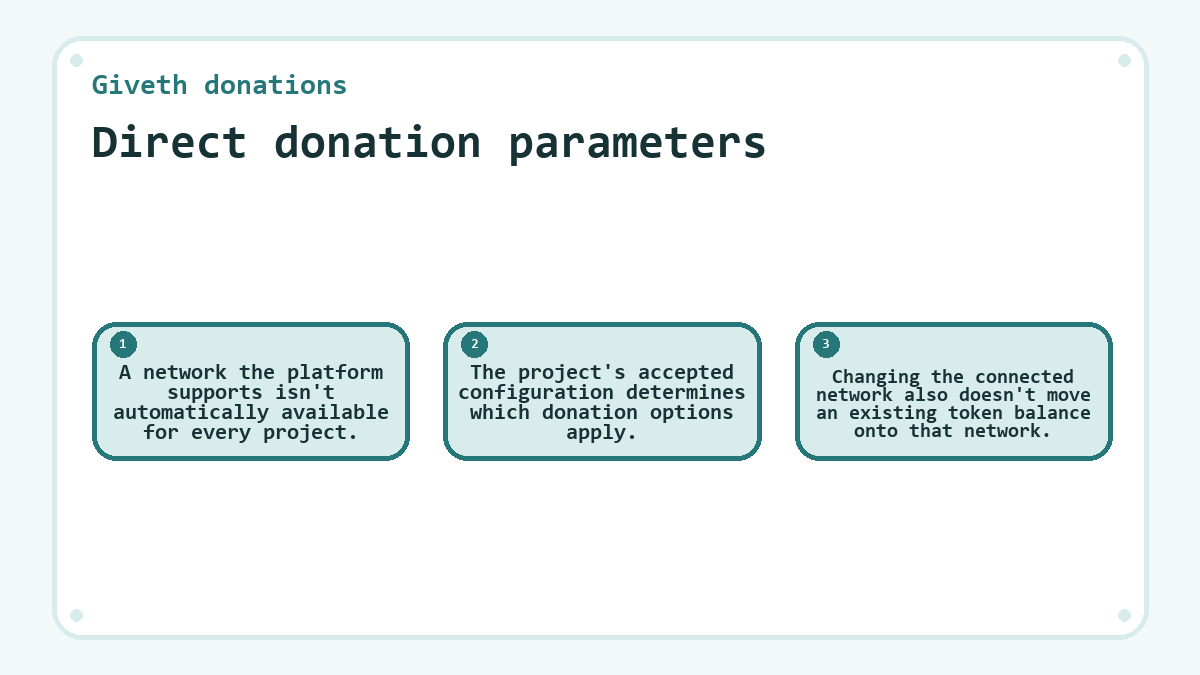
A network the platform supports isn't automatically available for every project. The project's accepted configuration determines which donation options apply. Changing the connected network also doesn't move an existing token balance onto that network.
Project purpose before payment
The project description should explain who will use the funds and what work the donation supports. A successful transfer answers where the tokens went. It doesn't establish whether the recipient has completed the proposed work.
Read the funding request alongside the project's updates. A description establishes the intended use; updates can explain progress, changes or spending. Look for a connection between the requested funds and the activity you want to support.
Project owners supply those updates. Their detail and frequency therefore affect how much you can learn after donating.
Listed status concerns publication criteria. Verified status concerns legitimacy and reputation; GIVbacks Eligible status additionally requires approval of the project's public-good activity and impact. None of these statuses turns a wallet transfer into milestone escrow. If your contribution requires approval before funds become available, a direct donation doesn't supply that condition. Resolve the funding arrangement before transferring control of the assets.
When has the project actually received the donation?
A direct donation completes when the blockchain successfully processes the transfer to the project's receiving address. Opening a wallet prompt or signing a message alone doesn't establish receipt. The transaction record must show successful execution with the intended recipient and asset.
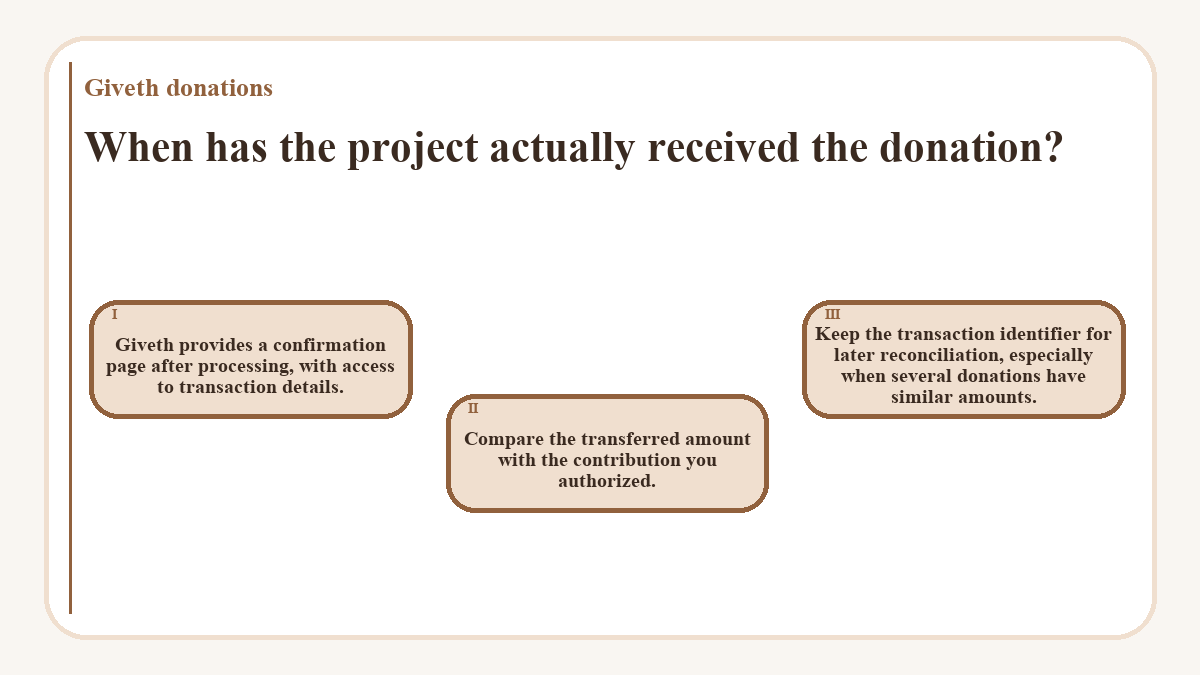
Giveth provides a confirmation page after processing, with access to transaction details. Compare the transferred amount with the contribution you authorized. Keep the transaction identifier for later reconciliation, especially when several donations have similar amounts.
A missing or delayed interface update isn't enough reason to submit another payment. Check the existing transaction first. An additional successful transfer would be another donation, rather than a refresh of the original one. This matters when the wallet and project page show different stages of processing.
Does project verification make a donation refundable?
Project verification doesn't create an automatic refund right or give Giveth custody of a direct donation. The recipient receives the funds through the transfer. Removing a project's reward eligibility doesn't reverse that payment or return the contribution to the sender.
Keep the funding decision separate from any expectation of rewards. A donation remains a contribution even if it doesn't produce GIVbacks. Verification can inform the decision to give, but it doesn't replace an agreement about the recipient's use of funds.
Repeat support and reward eligibility
Recurring donations provide continuing support through a funded stream. They use Superfluid on Optimism or Base and require a project configured to receive streams. Depositing eligible tokens into a Stream Balance makes them available for streaming. Funds flow to the project's anchor contract, where the owner can claim them. The stream continues until you end it or its Stream Balance runs out; it doesn't automatically draw more tokens from your wallet.
GIVbacks eligibility is a separate consideration. A successful donation doesn't by itself establish eligibility. GIVbacks uses a raffle, so qualifying contributions provide a chance to win GIV rather than a guaranteed reward. Project status, eligible tokens and the applicable round's conditions matter. These conditions don't change the network cost already incurred when sending the donation.
Choose recurring support when a continuing flow fits the project's funding needs and you intend to maintain its balance. Separate one-time gifts leave each later amount and payment date subject to a fresh decision.
What to know about Giveth donations
Can an unlisted Giveth project still receive a donation?
An active unlisted project can receive donations through its project page. Unlisted status limits discovery through the homepage, search and filters; it doesn't itself disable donations. Cancellation is a different status, so an unlisted project shouldn't be treated as a cancelled one.
How can I donate from a different wallet than the one I signed in with?
Giveth provides a change-wallet option in the account menu for selecting a different donation wallet. The newly selected wallet must have the appropriate funds on a network the project accepts. Signing into an account with one wallet doesn't transfer its balances to another.
What happens to gas fees if a donation transaction fails?
A transaction that executes and fails on Ethereum can still consume gas, even though the intended donation doesn't complete. A request rejected before submission hasn't incurred that execution cost. Distinguish an onchain failure from a wallet refusal when reviewing a balance change.
Does a Giveth transaction record establish a tax deduction?
A transaction record establishes details of a crypto transfer, not its tax treatment. Giveth doesn't support donors in obtaining tax deductions through ordinary direct donations. Receipt of GIVbacks also doesn't establish deductibility. The blockchain confirmation shouldn't be treated as a tax receipt.
Are project owners charged to receive direct donations?
Giveth doesn't charge project owners a platform fee for receiving direct donations. Costs a recipient later incurs to move or exchange the donated assets are separate from receipt of the gift. Those later actions don't change the original amount transferred to the project.
Will a direct donation automatically receive matching funds?
A direct donation affects matching only when it meets the applicable funding round's eligibility conditions. The donation must reach an eligible project during an active round, meet that round's minimum amount and use an eligible network. The donor must also satisfy the round's matching-verification requirements before it ends. Matching estimates aren't final allocations; the round's review and calculation determine the eventual distribution.